
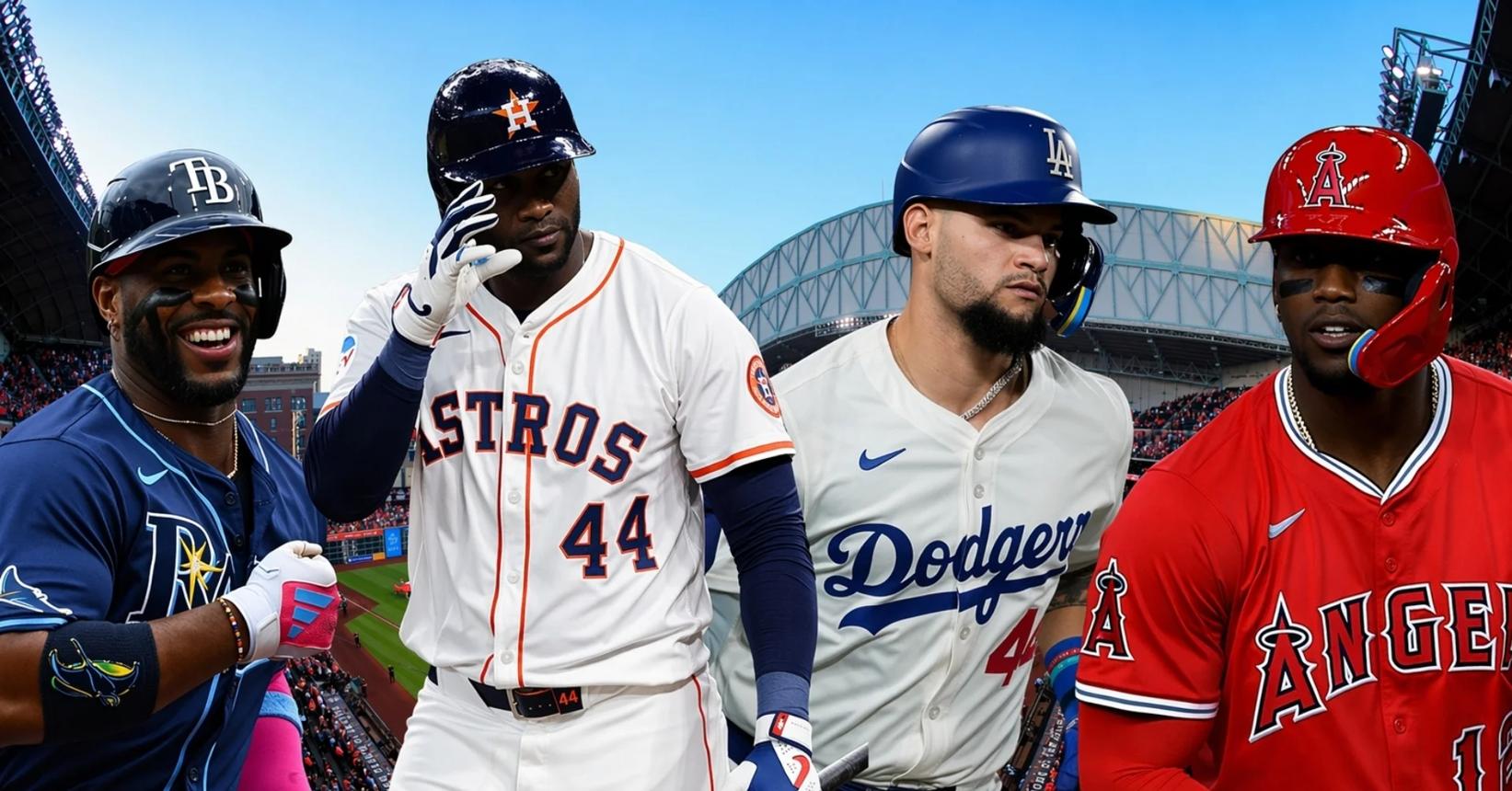
For more than a decade, Cuban baseball has demonstrated that its impact on Major League Baseball is not determined solely by the number of players reaching the highest level, but also by their performances and the individual honors they earn.
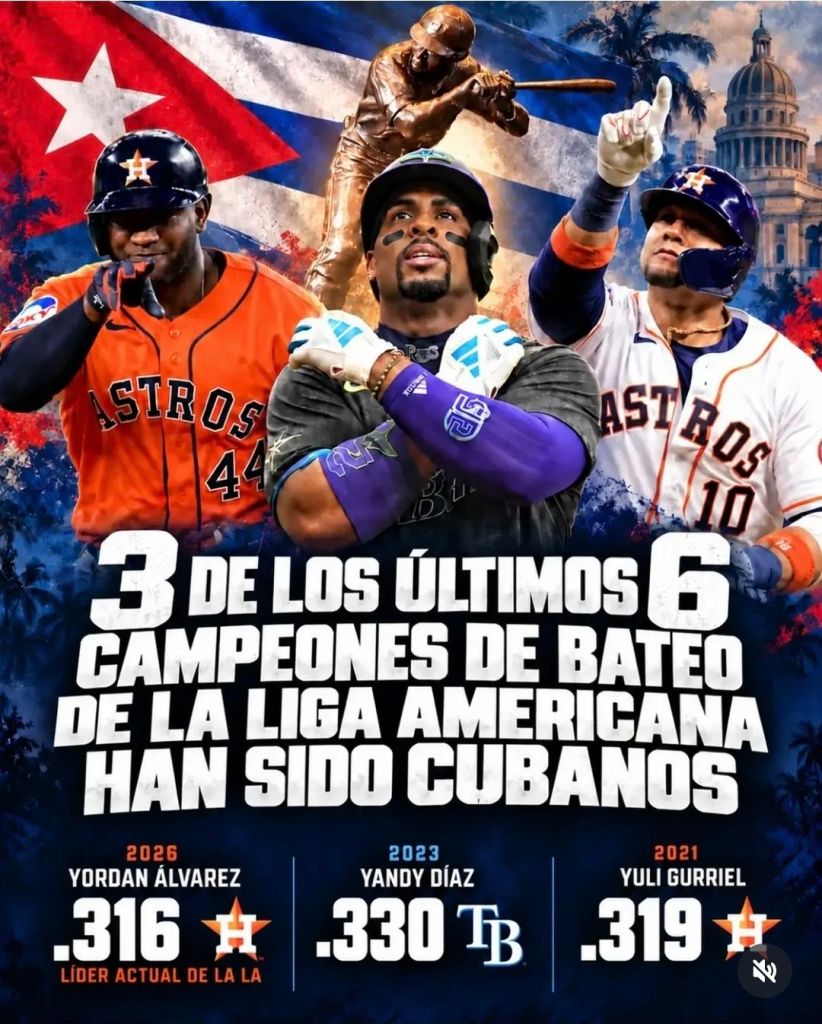
Three of the Last Six American League Batting Champions Are Cuban.
A statistical comparison between Cuba and the Dominican Republic since 2013, combined with the results of the 2026 MLB All-Star Game, provides an interesting perspective on the production of two of the Caribbean’s greatest baseball powers.
The difference becomes particularly significant when considering that the Dominican Republic has had a substantially larger player population in Major League Baseball than Cuba.
One of the most remarkable statistics is that three of the six American League batting titles awarded between 2021 and 2026 were captured by Cuban-born players.
Yuli Gurriel (.319 AVG):
The Cuban first baseman captured the American League batting crown, establishing himself as one of Houston’s most consistent offensive contributors.
Yandy Díaz (.330 AVG):
Díaz claimed the American League batting championship for Tampa Bay with one of the most productive offensive seasons of his career.
Yordan Álvarez (.316 AVG):
The slugger completed an extraordinary campaign with 42 home runs, 106 RBIs, and a 1.033 OPS, while also winning the American League Most Valuable Player Award.
Together, these three players accounted for 50% of the American League batting championships from 2021 through 2026. This accomplishment is particularly impressive considering Cuba’s relatively small representation in the Major Leagues compared with other Latin American baseball powers. It also highlights the consistency of Cuban hitters, who have continued to excel across multiple generations.
Cuba Leads Latin American Representation at the 2026 MLB All-Star Game
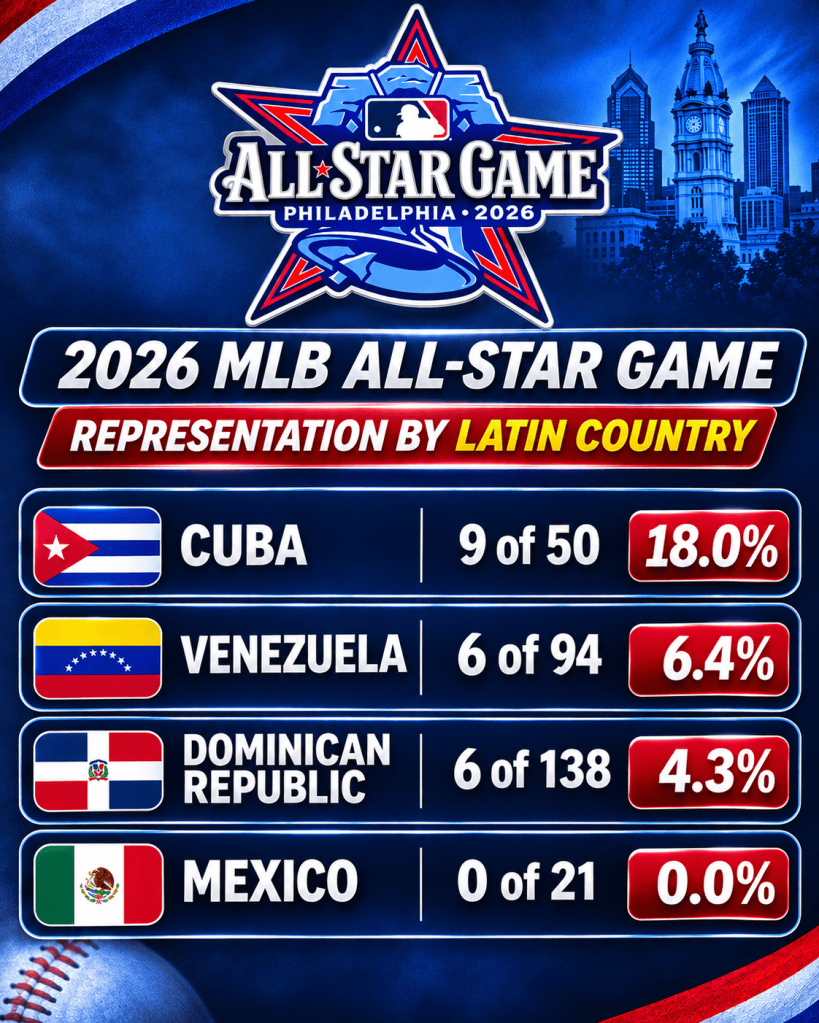
The 2026 MLB All-Star Game, held in Philadelphia, offered another compelling example of Cuban baseball’s impact. Using figures that include players born in each country and those of national descent, Cuba led a comparison involving four major Latin American baseball nations.
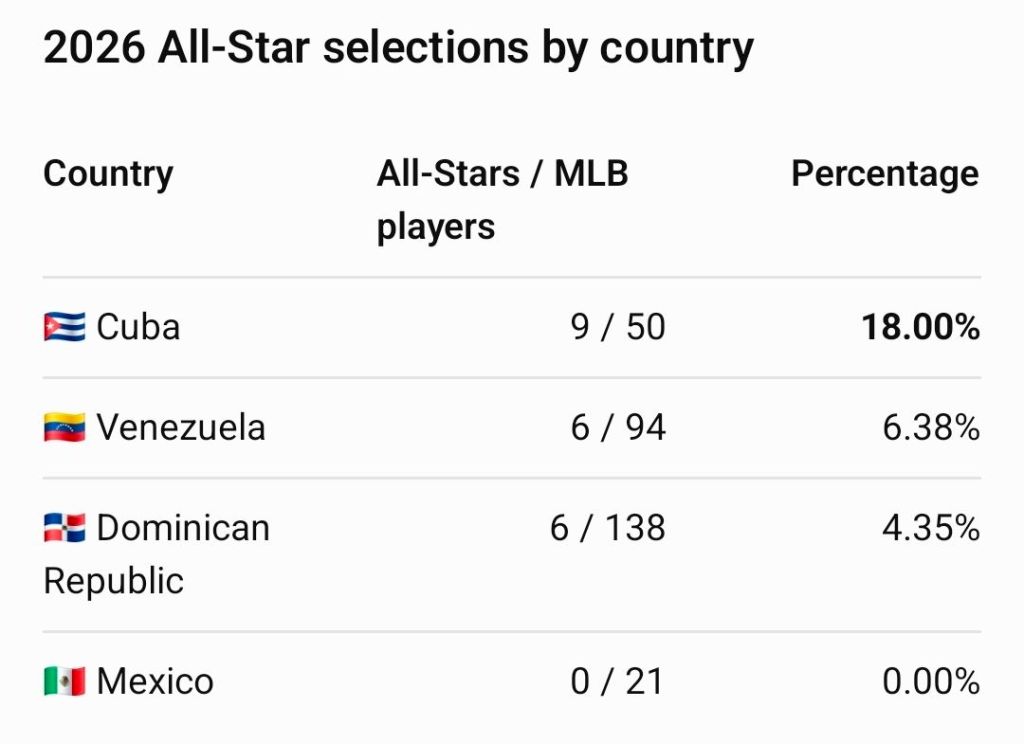
Cuba placed nine of its 50 players on the All-Star roster, representing an impressive 18% of its MLB player population.
That means nearly one out of every five Cuban or Cuban-American players included in this comparison earned an All-Star selection.
The Cuban percentage was approximately 2.8 times higher than Venezuela’s and 4.1 times higher than the Dominican Republic’s. Venezuela finished second with six selections among 94 players, while the Dominican Republic also contributed six All-Stars despite having 138 players in the Major Leagues.
Mexico did not have a selection among its 21 players.
These figures highlight an important distinction between the number of players a country sends to MLB and the percentage of those players who achieve All-Star recognition. Although All-Star selections alone cannot determine which country produces the best players, they provide a meaningful snapshot of the concentration of elite talent during a particular season.
Cuba vs. Dominican Republic: Individual MLB Awards Since 2013.
The 2026 All-Star comparison becomes even more interesting when examining individual awards and selections accumulated since 2013. For this analysis, the figures cover approximately 500 Dominican players and 90 Cuban and Cuban-American players between 2013 and 2026.
The comparison includes MVP awards, batting championships, Silver Sluggers, Gold Gloves, Players Choice Awards, All-Star selections, and All-MLB honors.
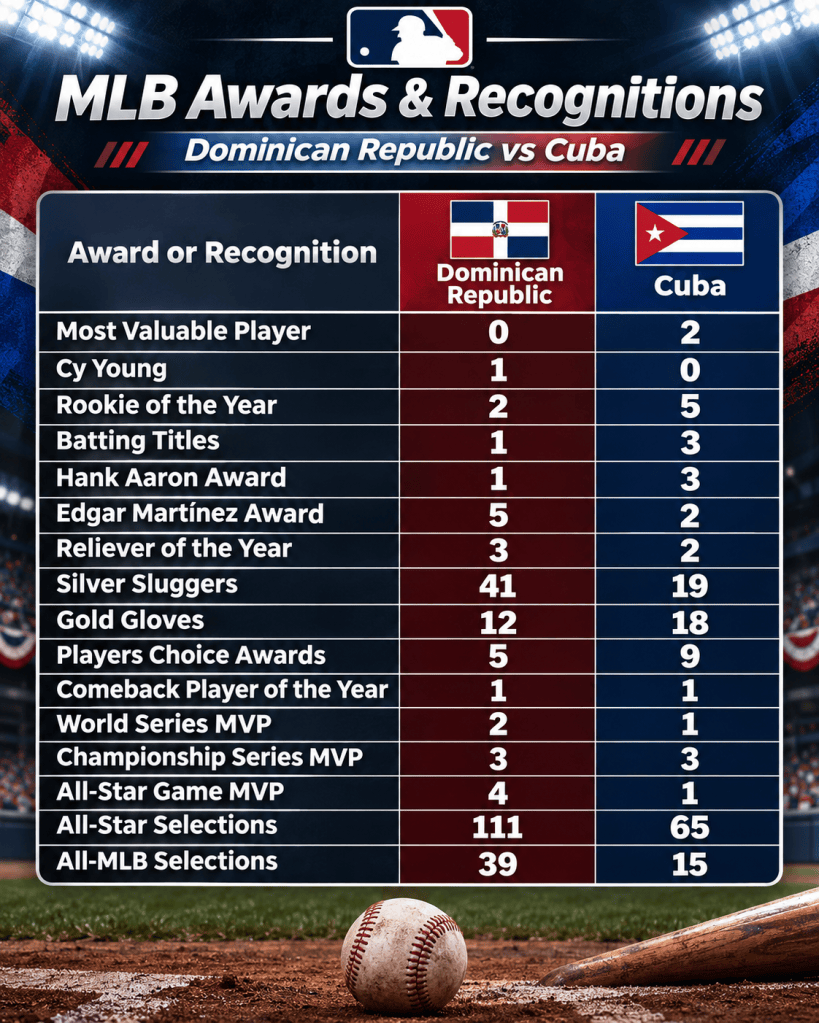
At first glance, the Dominican Republic leads comfortably in total awards and selections, 231 to 149. However, when these numbers are adjusted for the size of each country’s MLB player population, the comparison changes dramatically.
Cuba Averages 3.58 Times More Awards and Selections Per Player.
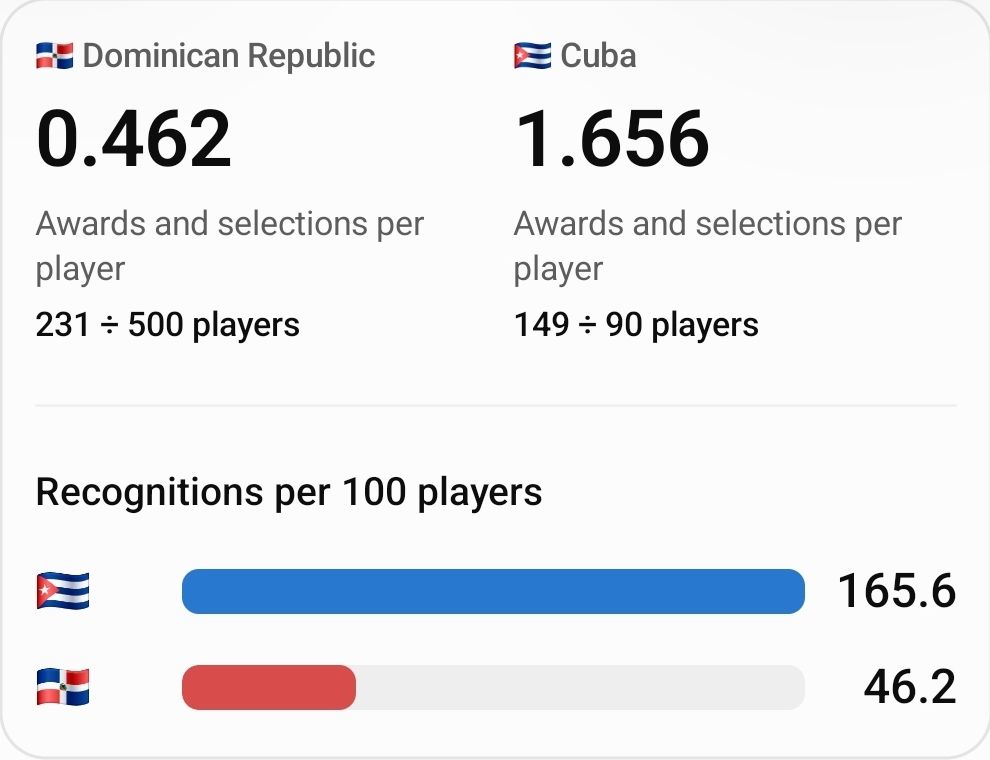
Based on the supplied figures, Cuban and Cuban-American players have accumulated approximately 3.58 times as many individual awards and selections per player as their Dominican counterparts since 2013.
The difference is particularly noticeable in certain categories. For example, Cuba has accumulated 18 Gold Gloves among 90 players, compared with 12 among 500 Dominican players.
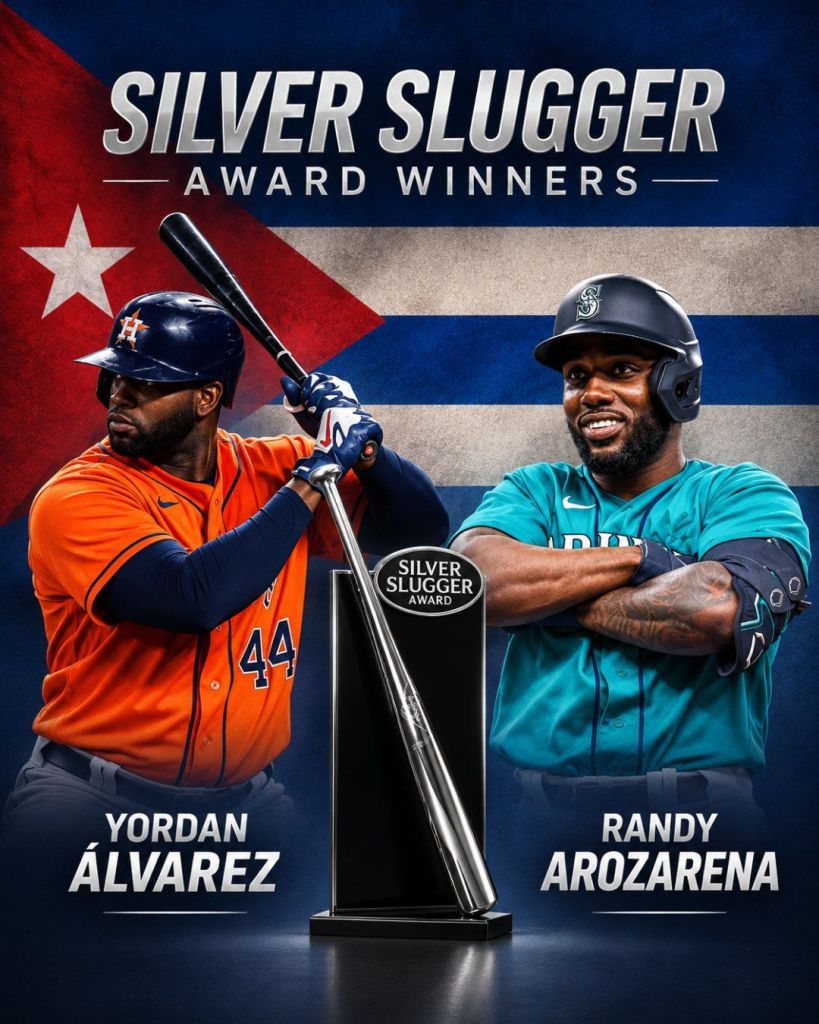
In Silver Slugger Awards, the Dominican Republic leads in total honors, 41 to 19. However, Cuba records a higher number relative to its player population.
The All-Star selections reveal a similar trend. Cuba has 65 selections compared with the Dominican Republic’s 111, despite having a much smaller pool of players.
These results reflect recognition rates, not the percentage of unique players who won awards. Individual stars can accumulate multiple honors over several seasons, significantly increasing their country’s totals.
Quantity vs. Quality: Two Different Ways to Evaluate Baseball Talent.
The Dominican Republic remains one of Major League Baseball’s most important international talent pipelines.
Its substantial player population has been a defining feature of the country’s baseball success for decades.
Cuba, meanwhile, has maintained a smaller MLB presence, influenced in part by political, migratory, and sporting circumstances that have historically affected the ability of Cuban players to reach the Major Leagues.
Despite those obstacles, Cuban-born and Cuban-American players have accumulated a remarkable number of individual accomplishments.
Nevertheless, evaluating a country’s overall baseball quality exclusively through awards has limitations. A more comprehensive analysis would incorporate career WAR, seasonal WAR, offensive and defensive production, pitching performance, playing time, longevity, and overall opportunities at the Major League level.
It would also require consistent criteria for identifying players born in each country and those with national ancestry, along with independently verified award totals. These considerations are important because a high concentration of awards may reflect the extraordinary achievements of a relatively small group of superstar players rather than the overall strength of an entire national player population.
Conclusion: Cuba Continues to Punch Above Its Weight in Major League Baseball.
The statistical picture reveals several compelling trends. Three of the last six American League batting champions have been Cuban-born players. Cuba also recorded the highest All-Star selection rate among the four Latin American countries examined in 2026, according to the supplied figures.
And across the broader 2013–2026 period, Cuban and Cuban-American players have accumulated a significantly higher number of awards and selections relative to their MLB player population.
The Dominican Republic maintains an advantage in total player representation and overall award volume. However, when the figures are adjusted for the number of players, Cuba’s recognition rate stands out.
This does not automatically establish that one country produces better baseball players than another. Instead, it demonstrates how a smaller national player population can generate an extraordinarily high concentration of elite performers.
From Yuli Gurriel and Yandy Díaz to Yordan Álvarez, Randy Arozarena, and the next generation of Cuban stars, Cuba continues to make a significant contribution to the highest level of professional baseball. The number of players tells one part of the story. Their production, individual accomplishments, and recognition tell another.
For Cuban baseball, the numbers illustrate a remarkable ability to produce major-league stars despite having a comparatively limited player population.