
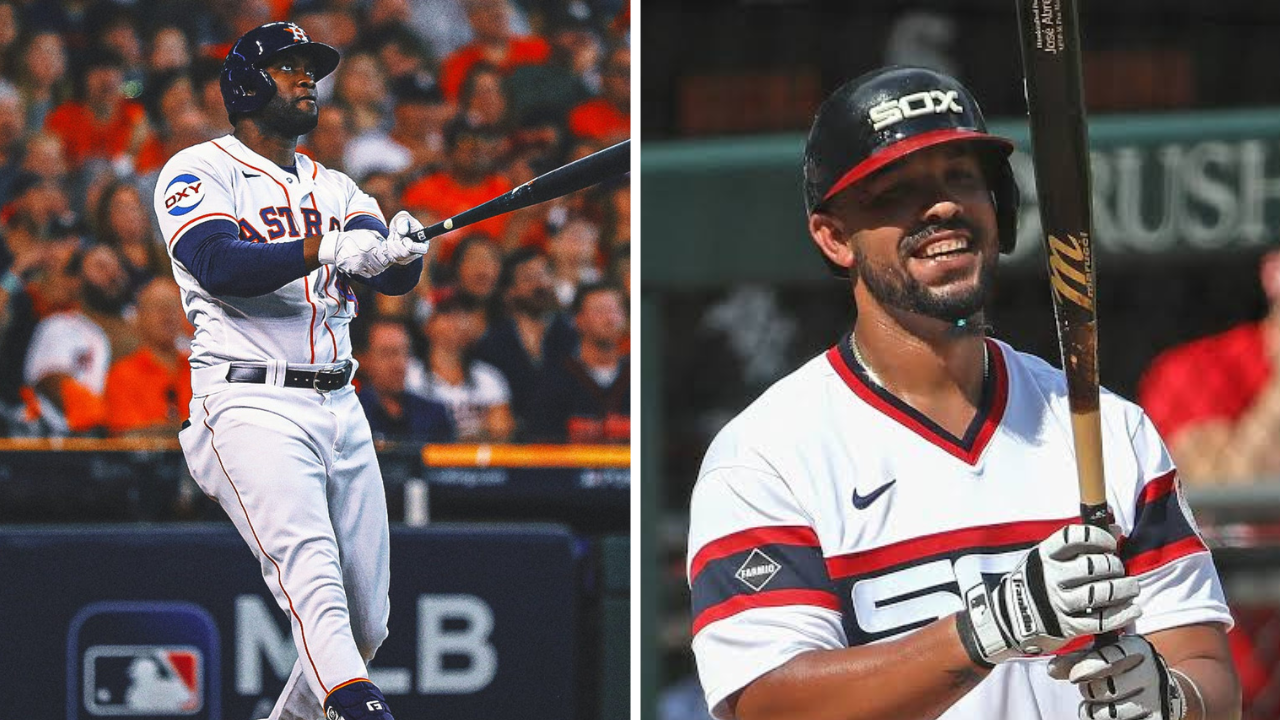
Two generations of Cuban baseball excellence collide in a statistical comparison that highlights the remarkable offensive abilities of José Abreu and Yordan Álvarez.
Cuba has produced some of the most accomplished hitters in Major League Baseball history, and few have made a greater offensive impact in recent years than José Abreu and Yordan Álvarez.
Both players have established themselves among baseball’s most dangerous hitters, combining power, run production, and an impressive ability to consistently make hard contact. While Abreu built his reputation through years of offensive consistency with the Chicago White Sox, Álvarez has emerged as one of the most feared sluggers in the game with the Houston Astros.
But how do these two Cuban stars compare statistically?
An examination of 14 traditional and advanced offensive metrics reveals a considerable advantage for Álvarez in the performances being compared. The Astros slugger leads in 12 categories, while Abreu holds the edge in hits and both players are tied in doubles.
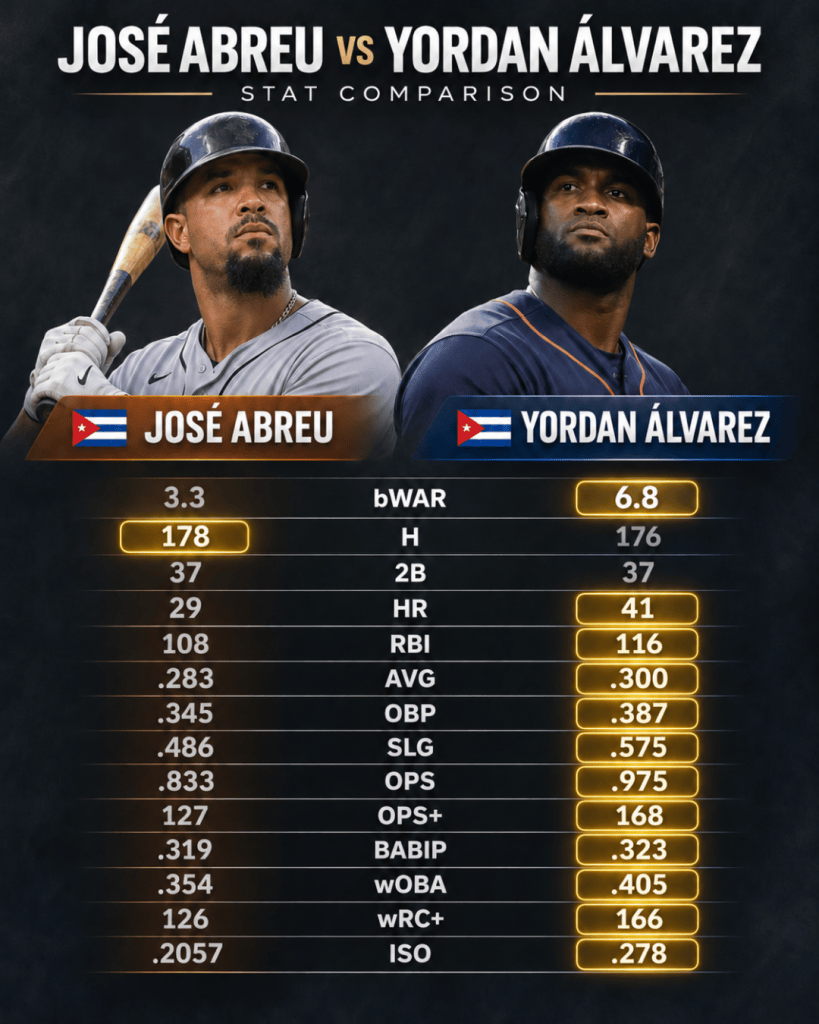
The comparison illustrates Álvarez’s offensive advantage in power, plate discipline, and overall production.
However, the numbers also reinforce Abreu’s reputation as a productive hitter capable of generating hits and driving in runs at a consistently high level.
Álvarez Holds a Significant Advantage in Power.
One of the most striking differences between the two players is their ability to generate power.
Álvarez recorded 41 home runs compared to Abreu’s 29, a difference of 12 long balls. That advantage is also reflected in slugging percentage, where Álvarez posted a .575 mark against Abreu’s .486.
The difference becomes even clearer when examining isolated power (ISO), a metric that measures a hitter’s ability to produce extra bases independently of batting average.
Álvarez’s .278 ISO considerably exceeds Abreu’s .2057, demonstrating the Astros slugger’s superior extra-base production in this comparison.
Both hitters recorded 37 doubles, but Álvarez’s substantially higher home run total gives him the overall edge in power.
Advanced Metrics Reveal an Even Bigger Gap.
While traditional statistics favor Álvarez, advanced offensive metrics provide an even more compelling argument.
One of the most important indicators is OPS+, which adjusts offensive performance for ballpark and league conditions.
Álvarez registered a 168 OPS+, meaning his offensive production was 68% above the league average. Abreu’s 127 OPS+ indicates production 27% better than average.
That 41-point difference highlights how much more productive Álvarez was relative to his offensive environment.
A similar advantage appears in weighted runs created plus (wRC+), another metric designed to measure overall offensive contributions while accounting for league and ballpark factors.
Álvarez posted a 166 wRC+, compared to Abreu’s 126, a significant 40-point separation.
The difference is also evident in weighted on-base average (wOBA), which assigns appropriate value to different offensive outcomes rather than treating every time reaching base equally.
Álvarez’s .405 wOBA substantially exceeds Abreu’s .354, reinforcing the advantage demonstrated by the other offensive metrics.
Combined, these statistics suggest that Álvarez delivered considerably greater offensive value in the performances examined.
Abreu’s Strength: Consistency and Run Production.
Despite Álvarez’s statistical advantage, José Abreu’s offensive accomplishments should not be overlooked.
Abreu recorded 178 hits, two more than Álvarez’s 176, demonstrating his ability to consistently put the ball in play and reach base through hits.
His 108 RBIs also reflect his effectiveness as a middle-of-the-order run producer, although Álvarez holds a slight advantage with 116.
Abreu’s .283 batting average, .345 on-base percentage, and .486 slugging percentage represent strong offensive production.
In fact, a .833 OPS and 127 OPS+ are indicators of an above-average major league hitter.
What makes Abreu particularly remarkable is that his success was not limited to a single outstanding season.
After arriving in Major League Baseball in 2014, Abreu quickly established himself as one of the American League’s most productive first basemen.
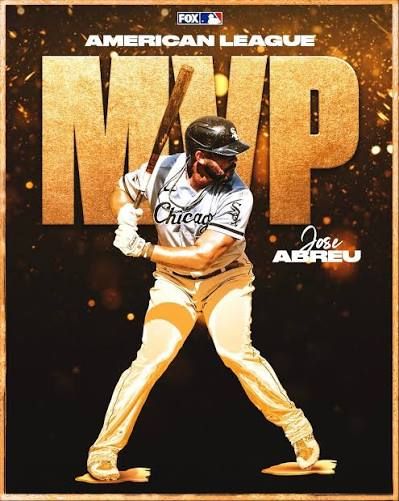
He captured the 2014 American League Rookie of the Year Award and later earned the 2020 AL Most Valuable Player Award.
His combination of power, consistency, and run production helped establish him as one of the most accomplished Cuban-born hitters of his generation.
The WAR Comparison: Álvarez Nearly Doubles Abreu.
Another substantial difference appears in Baseball-Reference Wins Above Replacement (bWAR).
Álvarez recorded 6.8 bWAR compared to Abreu’s 3.3, a difference of 3.5 wins.
That means Álvarez generated more than twice Abreu’s total value above replacement level in the performances being compared.
However, WAR measures overall player value rather than offensive production alone. Positional adjustments, defense, and other factors contribute to the calculation.
Nevertheless, Álvarez’s advantage is impressive, particularly considering that much of his value comes from his offensive contributions.
Does This Make Yordan Álvarez the Better Hitter?
Based strictly on the statistics presented, the answer favors Yordan Álvarez.
The Houston slugger leads in batting average, on-base percentage, slugging percentage, OPS, OPS+, wOBA, wRC+, isolated power, home runs, and RBIs.
His ability to combine a high batting average with elite power makes him particularly dangerous.
Álvarez is not simply a home run hitter. He possesses the ability to hit for average, reach base consistently, and deliver substantial extra-base production.
That offensive versatility is reflected throughout the statistical comparison.
However, determining which player has enjoyed the better overall career requires a broader evaluation.
Abreu’s longevity, durability, career accomplishments, and extended period of offensive success deserve consideration.
Meanwhile, Álvarez’s offensive ceiling and impressive advanced metrics suggest that he possesses the potential to establish an even greater legacy among Cuban hitters in Major League Baseball.
There is also an important distinction between comparing individual statistical performances and comparing entire careers. The figures examined here establish a clear advantage in this particular statistical matchup, but they do not, by themselves, settle the debate over career greatness.
Two Generations, One Cuban Baseball Legacy.
José Abreu and Yordan Álvarez represent two outstanding chapters in the history of Cuban baseball.
Abreu helped continue the tradition of Cuban power hitters in the Major Leagues, following the accomplishments of legends such as José Canseco, Rafael Palmeiro, and Tony Pérez.
Álvarez has carried that tradition forward, establishing himself as one of the game’s elite offensive talents.
Their statistical profiles reflect two different strengths. Abreu built his reputation through consistency, durability, and sustained run production, while Álvarez has demonstrated extraordinary offensive efficiency and power.
In this comparison, Álvarez leads 12 of the 14 statistical categories, Abreu leads one, and the two players are tied in another.
The numbers overwhelmingly favor Álvarez, particularly when examining advanced metrics that measure overall offensive productivity.
But baseball greatness is about more than a single statistical comparison. Longevity, consistency, peak performance, awards, and postseason accomplishments also shape a player’s legacy.
For Cuban baseball fans, the debate represents something worth celebrating: two exceptional hitters who have helped maintain Cuba’s reputation as one of baseball’s great talent-producing nations.
The ultimate question remains: Has Yordan Álvarez already surpassed José Abreu as a hitter, or does Abreu’s sustained excellence still give him the advantage when comparing their legacies?
One thing is certain: both players have earned their places among the outstanding Cuban hitters of their respective generations.