
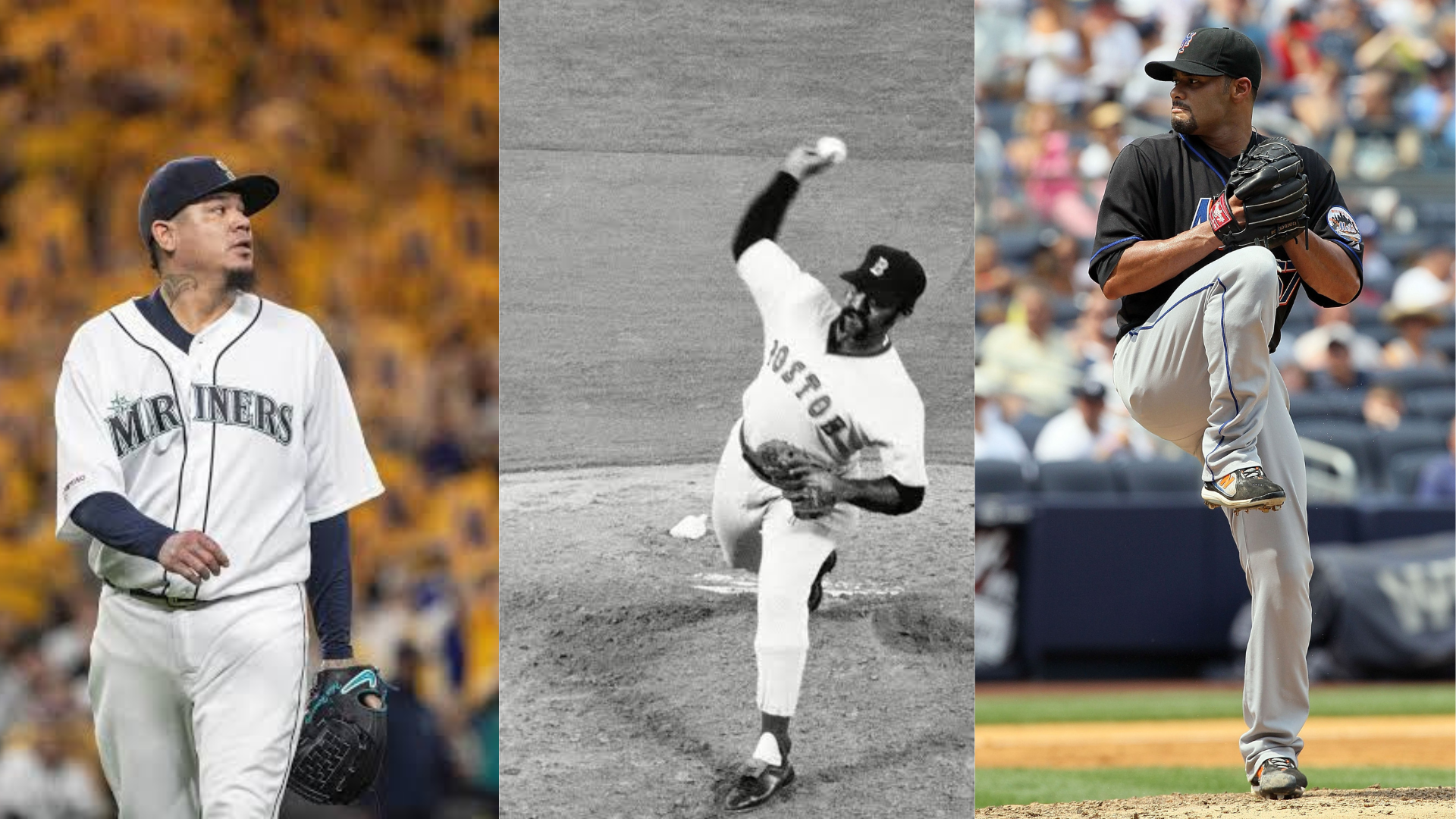
Throughout Major League Baseball history, Latin American pitchers have established themselves among the game’s most dominant performers. Three names that deserve serious consideration when discussing the greatest pitchers from the region are Cuba’s Luis Tiant and Venezuela’s Félix Hernández and Johan Santana.
All three enjoyed outstanding careers, combining individual brilliance, impressive statistical achievements, and unforgettable performances. Yet each built his legacy differently. Tiant distinguished himself through longevity, durability, and an extraordinary ability to win games. Hernández became one of the most dominant workhorses of his generation, while Santana produced arguably the most impressive peak of the three.
The question is simple: Who had the greatest MLB career, and which of these pitchers deserves a place in Cooperstown?
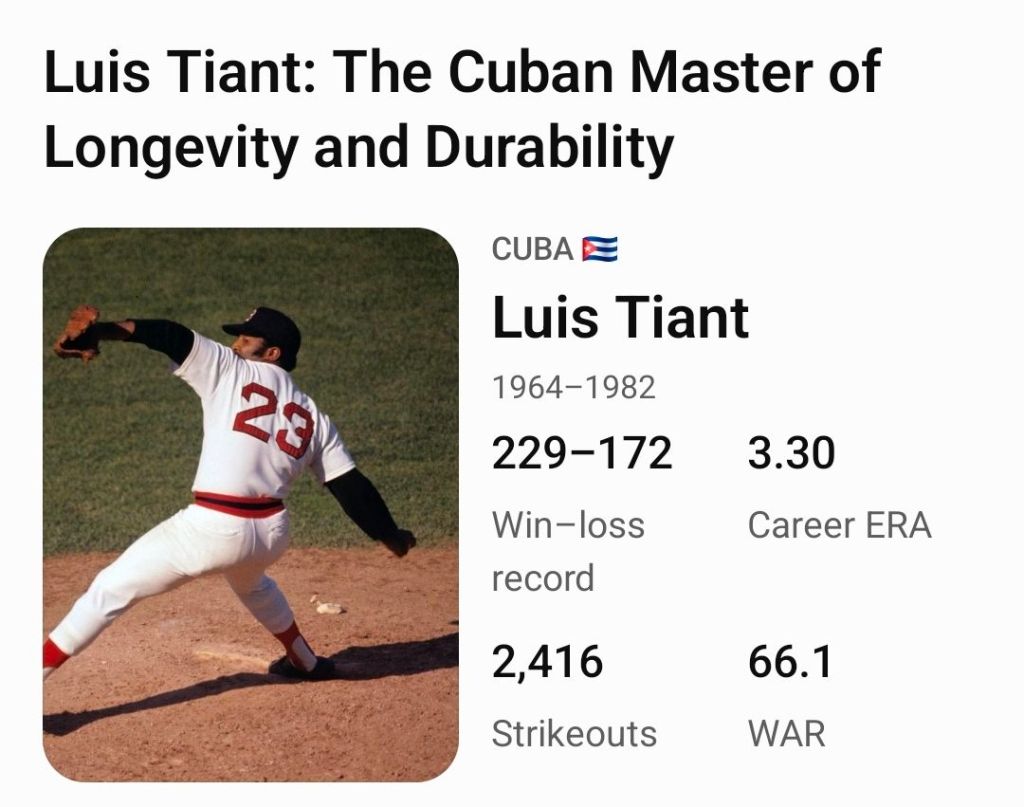
When evaluating the three pitchers through the lens of career longevity and overall accumulated value, Luis Tiant emerges as a particularly compelling candidate.
The Cuban right-hander spent 19 seasons in the Major Leagues, compiling 229 victories, 2,416 strikeouts, and a 3.30 earned run average across 3,486⅓ innings.
His 66.1 career WAR stands comfortably ahead of Santana’s 51.7 and Hernández’s 49.8.
Perhaps even more impressive is Tiant’s durability. He pitched nearly 760 more innings than Hernández and more than 1,460 innings beyond Santana’s career total.
Tiant also won two American League ERA titles and earned three All-Star selections.
His remarkable 1968 campaign with Cleveland remains among the most dominant seasons ever produced by a Cuban pitcher. That year, Tiant finished 21–9 with a spectacular 1.60 ERA, demonstrating his ability to dominate hitters during an era filled with legendary pitching talent.
Although he never captured a Cy Young Award, his combination of longevity, effectiveness, and career accomplishments creates a powerful argument for his historical standing.
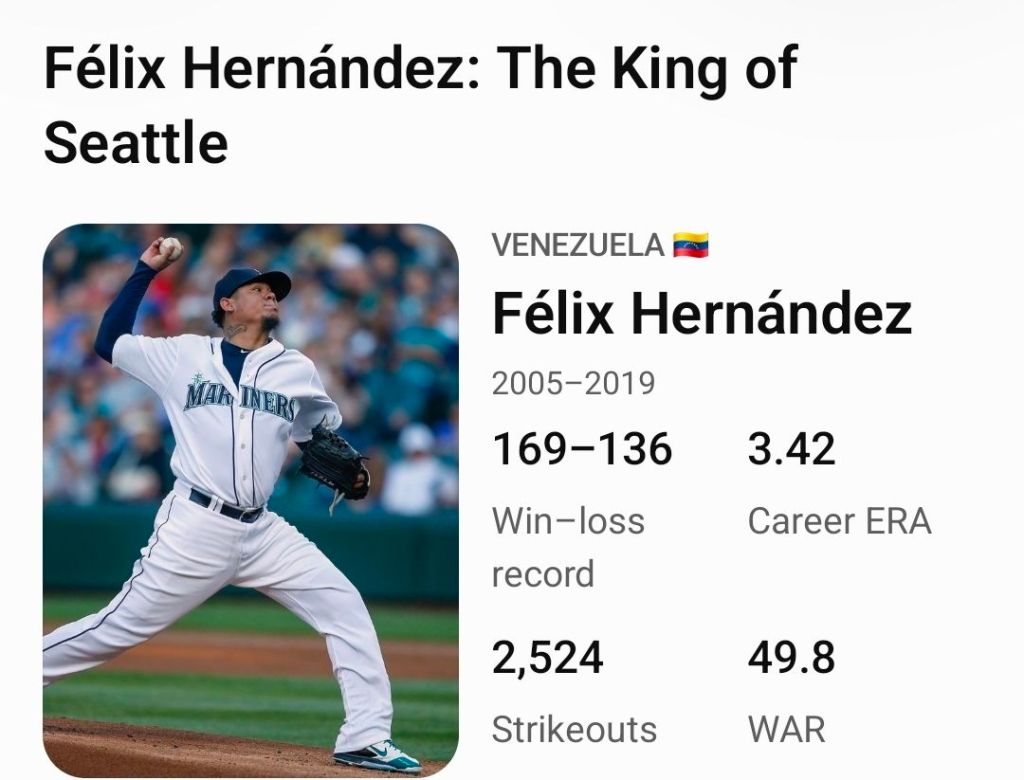
Few pitchers of the 21st century inspired the loyalty and admiration that Félix Hernández commanded throughout his career with the Seattle Mariners.
Affectionately known as “King Félix,” the Venezuelan right-hander became the face of Seattle’s pitching staff and one of the most recognizable pitchers in baseball.
Hernández finished his MLB career with 169 victories, 2,524 strikeouts, a 3.42 ERA, and 49.8 WAR.
Among the three pitchers, Hernández leads in career strikeouts and All-Star selections, with six.
His finest individual achievement came in 2010, when he captured the American League Cy Young Award despite finishing with a 13–12 record. His selection helped reinforce the growing recognition that pitcher evaluation should extend beyond traditional win totals.
During that season, Hernández posted a 2.27 ERA across 249⅔ innings, leading the American League in both categories.
Two years later, he authored one of baseball’s most memorable performances, throwing a perfect game against the Tampa Bay Rays on August 15, 2012.
Hernández’s career demonstrates why victories alone cannot adequately measure pitching excellence. Despite consistently delivering dominant performances, he often pitched for Seattle teams that struggled to provide sufficient offensive support.
His legacy rests on his sustained excellence, impressive strikeout totals, and the extraordinary consistency he displayed during his prime.
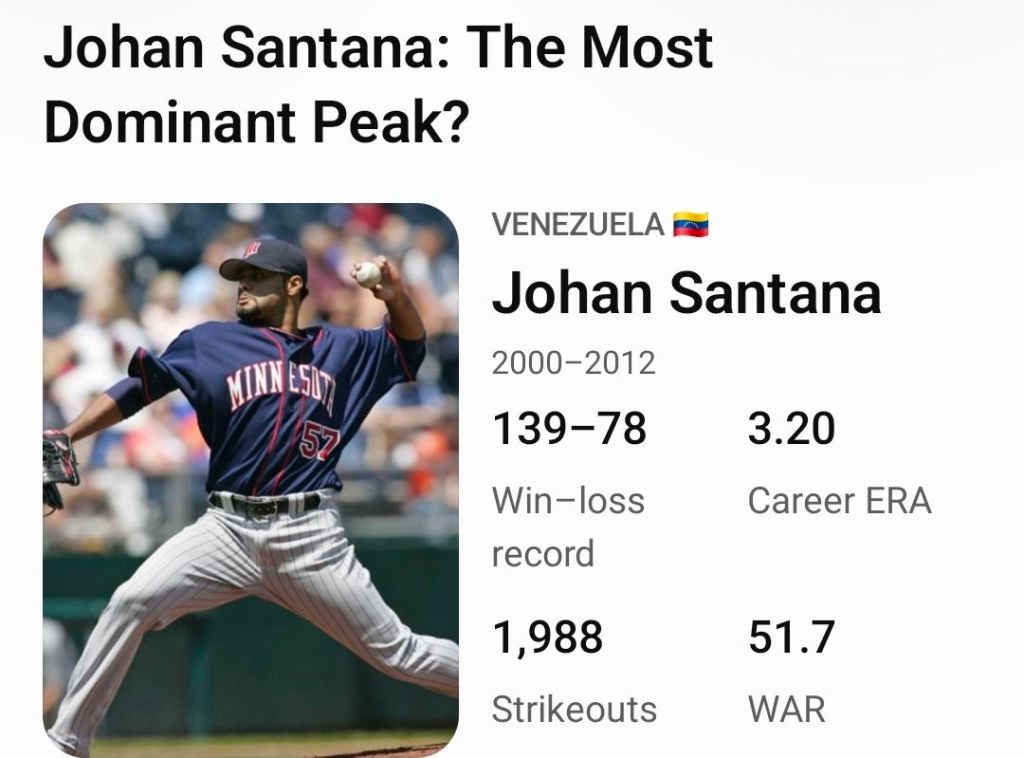
If the debate shifts from career longevity to peak dominance, Johan Santana may possess the strongest argument of the three.
The Venezuelan left-hander finished his career with a 139–78 record, a 3.20 ERA, 1,988 strikeouts, and 51.7 WAR.
Although Santana accumulated fewer victories and innings than Tiant and Hernández, his advanced statistics reveal a pitcher who was exceptionally effective when healthy.
His career 136 ERA+ is substantially higher than Hernández’s 117 and Tiant’s 114, meaning Santana performed approximately 36% better than the league average in adjusted earned run prevention.
Santana also leads the trio with two Cy Young Awards, three ERA titles, and a pitching Triple Crown.
His incredible stretch from 2004 through 2008 established him as arguably the best starting pitcher in baseball during that period.
In 2004, Santana finished 20–6 with a 2.61 ERA and 265 strikeouts, capturing his first American League Cy Young Award.
Two seasons later, he claimed his second Cy Young Award and the pitching Triple Crown, leading the American League in wins, ERA, and strikeouts.
His devastating changeup became one of baseball’s most feared pitches.
Santana later made history with the New York Mets, throwing the franchise’s first no-hitter on June 1, 2012.
Unfortunately, shoulder injuries significantly shortened his career, preventing him from accumulating the totals that might have strengthened his Hall of Fame candidacy.
Nevertheless, his statistical dominance during his prime remains difficult to overlook.
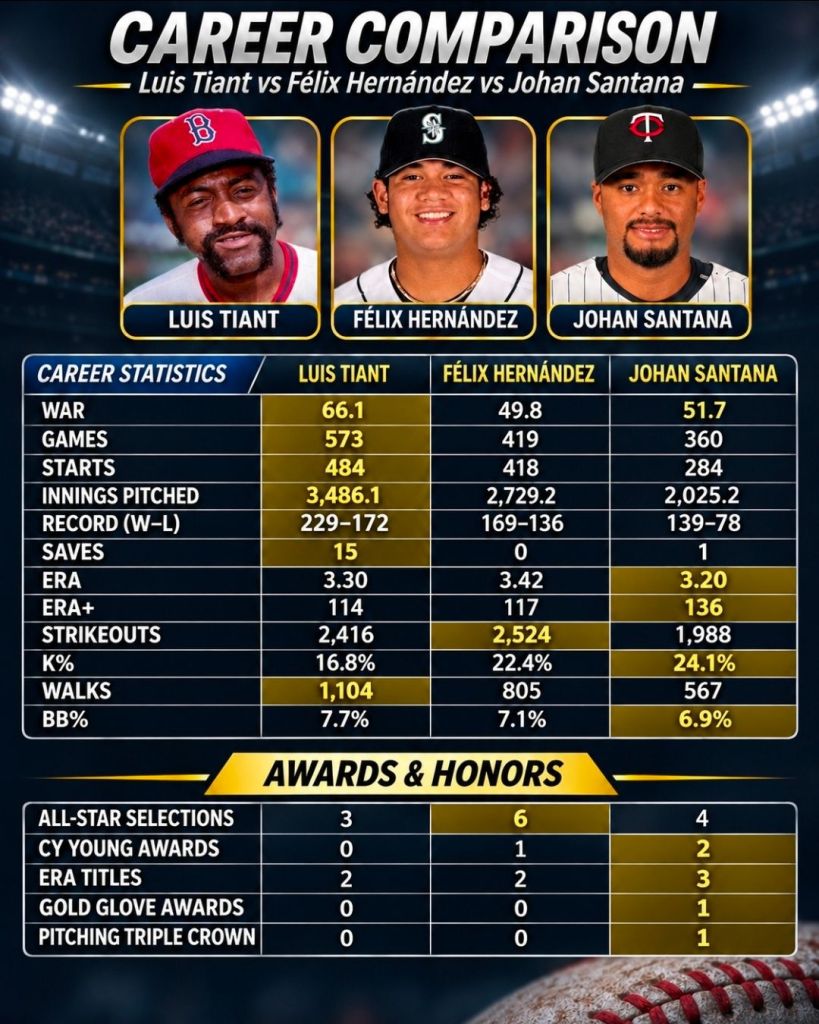
The differences are especially revealing.
Tiant produced the greatest accumulated statistical value, pitching considerably longer than his Venezuelan counterparts while maintaining an impressive level of effectiveness.
Hernández recorded the most strikeouts and received the most All-Star selections, highlighting his sustained reputation as one of the American League’s premier starters.
Santana, meanwhile, delivered the strongest ERA and ERA+ while collecting more Cy Young Awards and ERA titles than either rival.
Each pitcher, therefore, can claim superiority in a different dimension of the game.
The Hall of Fame Debate.
The comparison becomes even more interesting when considering their places in baseball history.
Tiant’s Hall of Fame case is largely built around his longevity, 229 victories, career WAR, and outstanding postseason performances. His absence from Cooperstown has generated considerable debate among baseball historians and fans.
Hernández represents a different challenge for Hall of Fame voters. His 169 career victories fall below the traditional benchmarks historically associated with induction, but modern statistical analysis provides a more favorable interpretation of his accomplishments.
Santana’s candidacy is perhaps the most fascinating. His two Cy Young Awards and remarkable peak place him among the elite pitchers of his generation, yet injuries prevented him from reaching the career milestones generally associated with Hall of Fame starters.
His case raises an important philosophical question: Should baseball’s highest individual honor reward sustained longevity or extraordinary dominance over a shorter period?
There is no universally accepted answer.
Final Verdict: Longevity vs. Peak Dominance.
When comparing these three Latin American pitching legends, the evidence suggests that no single statistic can adequately determine who had the greatest career.
Luis Tiant has the strongest argument based on career longevity, WAR, victories, and accumulated value. His ability to remain effective over nearly two decades distinguishes him from the other two pitchers.
Johan Santana presents the most compelling argument based on peak dominance. His superior ERA+, two Cy Young Awards, and pitching Triple Crown demonstrate how thoroughly he dominated opposing hitters during his prime.
Félix Hernández occupies an important position between the two, combining considerable durability with elite strikeout production, a Cy Young Award, and one of the most memorable perfect games in MLB history.
Ultimately, the distinction between the greatest career and the greatest peak is essential.
Tiant accumulated more value over a longer period. Santana reached a higher level of dominance relative to his contemporaries. Hernández demonstrated exceptional sustained excellence while often competing without the offensive support necessary to maximize his victory totals.
Their achievements also illustrate the remarkable contributions of Cuba and Venezuela to Major League Baseball history.
Three legendary pitchers. Three extraordinary careers. Three different arguments for greatness. The question remains: If you could select only one of these pitchers to enter the Baseball Hall of Fame, would you choose Luis Tiant, Félix Hernández, or Johan Santana?